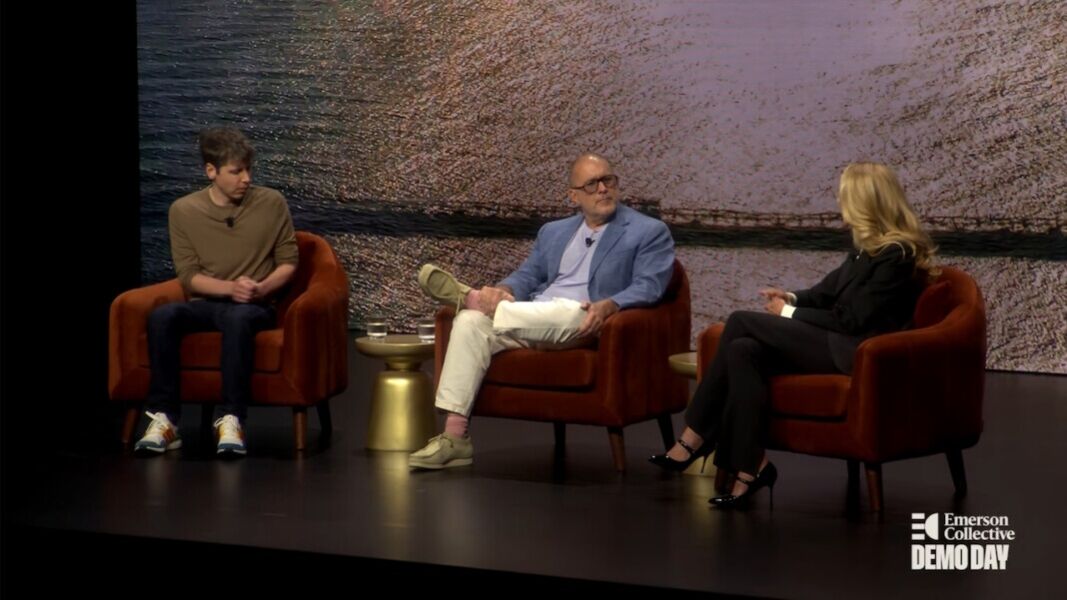
Breaking months of silence following reports of technical setbacks, Jony Ive and Sam Altman have confirmed their $6.5 billion artificial intelligence (AI) hardware venture is on track for a release in “less than two years.”
Speaking at the Emerson Collective Demo Day, the duo revealed a finalized prototype that pivots away from pure utility toward “whimsy” and “joy.”
This update directly counters recent speculation that software and privacy hurdles had stalled the project, tentatively referred to as “IO” despite a standing federal trademark injunction.
Altman framed the device as an antidote to the sensory overload of modern smartphones, aiming to fundamentally reshape the digital economy.
A Defiant Timeline: “Less Than Two Years”
Far from the utilitarian rhetoric that typically surrounds AI hardware, the joint appearance at the Emerson Collective Demo Day marked a pivotal moment for the partnership, offering the first substantive update since OpenAI’s $6.5 billion acquisition of ‘io’ in May 2025.
While the initial merger brought together Ive’s LoveFrom designers and OpenAI’s technical leadership under a massive valuation, the project had subsequently gone dark, fueling industry speculation about its viability.
The silence was broken not with a formal press release, but through a candid exchange with Laurene Powell Jobs. When pressed on a release window, initially suggested by Powell Jobs as “within five years”, Ive explicitly narrowed the horizon.
He corrected the estimate to “much sooner,” and when asked if “two years” was accurate, he sharpened the target further, stating the timeline is “even less than that.”
This projection implies a market launch in late 2026 or 2027, offering a concrete target after months of ambiguity.
Validating the roadmap, this confirmation serves as a direct and necessary rebuttal to October reports of technical hurdles. Those reports had suggested the project was struggling with fundamental issues, including privacy frameworks for an “always-on” device and the computing infrastructure required to support it.
The confident timeline suggests that the team, comprising former Apple veterans like Tang Tan and Evans Hankey alongside OpenAI’s researchers, has navigated these early bottlenecks.
The path to this timeline was described as an arduous process of elimination. Ive noted that for months, the team faced “all the problems and all the reasons why it shouldn’t exist,” requiring a “leap of intuitive faith” to proceed.
However, the turning point appears to have been the completion of a specific, finalized prototype that met the team’s exacting standards.
Altman revealed that the project had previously stalled on an earlier iteration that was functional but lacked the necessary emotional resonance.
Distinguishing the current model, which he described as “jaw-dropping” from failed earlier attempts, Altman shared a specific anecdote about the tactile quality required for approval:
“There was an earlier prototype that we were quite excited about, but I did not have any feeling of, ‘I want to pick up that thing and take a bite out of it.’ And then finally we got there all of a sudden.”
The prototype hardware apparently has overcome the “personality” and software integration issues rumored to be stalling progress just weeks ago, moving from a theoretical concept to a physical reality ready for production planning.
OpenAI reportedly relies on the same supply chain partners as Apple, such as Luxshare and Goertek.
Designing for “Whimsy” in a “Times Square” World
Speaking to a curated audience, Altman critiqued the current state of personal technology, comparing the modern smartphone experience to a sensory assault.
He described the feeling of using current devices as “walking through Times Square in New York and constantly just dealing with all the little indignities along the way… flashing lights in my face, tension going here, people bumping into me.”
Functionally, the new hardware aims to pivot the user experience toward a fundamentally different environment. Altman explained that users could opt for a vibe that was instead “like sitting in the most beautiful cabin by a lake.”
To achieve this “cabin” effect, the device relies on a sophisticated form of ambient computing that filters the digital noise of daily life. Describing the mechanism, Altman explained:
“If you have this really smart AI that you trust to do things for you over long periods of time, filter things out. Be able to be contextually aware of when it should, not only not really bother you, but when it should present information to you or ask for your input or not.”
By filtering noise, this mechanism attempts to solve the “always-on” privacy paradox by making the device a passive filter rather than an active intruder.
Explicitly rejecting pure utilitarianism, the design philosophy emphasizes that efficiency is not the sole metric of success. Ive noted that he prefers solutions that “teeter on appearing almost naive in their simplicity.”
Emotion, rather than function, drives the product mandate. Ive insisted that the team is going to “make people smile. We’re going to make people feel joy. Whatever the product does, it has to do that,” a distinct contrast to the productivity-first marketing that dominates the current AI landscape.
The “Transistor” Thesis: Beyond Consumer Gadgets
Altman moved beyond product specifications to frame the device’s economic significance, positioning it not merely as a consumer accessory but as a foundational economic enabler. He drew a direct historical parallel:
“The transistor is my favorite analogy for what AI is like. It’s like discovering a new property of physics. The scaling process of the transistor over time versus the way LLMs have scaled the economic place that it had, where the transistor companies themselves, with a small number of exceptions, never got that big, but they kind of seeped throughout the entire economy and lifted everything up.”
Strategically, this suggests OpenAI is attempting to own the physical distribution layer for Artificial General Intelligence (AGI). Unlike the iPhone, which centralized computing into a single screen, this device aims to disperse intelligence into the environment.
Aligning with OpenAI’s broader push into custom chips and data centers, this “infrastructure-first” mindset positions the hardware endpoint as a potential loss leader, securing a vertical stack for high-value AI services.
The “IO” Brand and Market Reality
While the timeline offers clarity, the branding situation remains opaque. During the event, Laurene Powell Jobs repeatedly referred to the venture as “IO.”
This contradicts a June 2025 federal court order that forced OpenAI to scrub the branding following a trademark lawsuit from Iyo, a Google spinoff.
It remains unclear if the parties have reached a quiet settlement or if the terminology was a colloquial slip, but the legal injunction remains a significant hurdle for the product’s go-to-market strategy.
Skepticism also surrounds the venture, which analysts have termed a high-stakes gamble, following the high-profile failure of the Humane AI Pin. That device suffered from overheating, lag, and poor battery life.
Meta’s Ray-Ban smart glasses currently dominate the “screen-free” category, setting a high bar for style and social acceptability. Even with a “whimsical” design, the device must contend with the hard reality of privacy concerns, as a device that “knows everything you’ve ever thought” requires unprecedented user trust.