Hollywood powerhouse Creative Artists Agency (CAA) has publicly condemned OpenAI’s new Sora 2 video generator, escalating the battle over AI and intellectual property.
In a sharp statement on October 8, the agency labeled the app a “significant risk” to its clients and accused OpenAI of blatantly dismissing creators’ rights.
The rebuke highlights a growing industry-wide revolt against the AI firm’s practices. It comes just days after OpenAI, facing initial backlash, reversed its controversial copyright policy to an opt-in model. CAA’s declaration signals that this change was insufficient for Hollywood’s creative leaders.
As one of the most powerful talent agencies, representing A-listers from film, music, and sports, CAA’s public rebuke carries immense weight. It transforms the debate from online chatter into a high-stakes corporate confrontation between Silicon Valley and the creative industries.
The agency is demanding stronger guarantees for control, permission, and compensation for its artists. This move signals a significant hardening of the entertainment industry’s stance against the perceived overreach of Big Tech in the new era of generative AI.
Hollywood Draws a Line in the Sand
In its forceful statement, CAA questioned OpenAI’s entire approach to intellectual property, writing in a statement:
“CAA is unwavering in our commitment to protect our clients and the integrity of their creations. The misuse of new technologies carries consequences that reach far beyond entertainment and media, posing serious and harmful risks to individuals, businesses, and societies globally. It is clear that Open AI/Sora exposes our clients and their intellectual property to significant risk. The question is, does OpenAI and its partner companies believe that humans, writers, artists, actors, directors, producers, musicians, and athletes deserve to be compensated and credited for the work they create?
Or does Open AI believe they can just steal it, disregarding global copyright principles and blatantly dismissing creators’ rights, as well as the many people and companies who fund the production, creation, and publication of these humans’ work? In our opinion, the answer to this question is obvious. Control, permission for use, and compensation is a fundamental right of these workers. Anything less than the protection of creators and their rights is unacceptable.
We are open to hearing the solutions that Open AI has to these critical issues and remain steadfast in our work with intellectual property businesses and leaders, and creative guilds and unions, as well as state and federal legislators and global policymakers, to answer these challenges and set an aligned path for the future.”
This frames the conflict not as a simple policy dispute but as a core issue of labor and creative rights.
The agency’s pointed questions challenge the “move fast and break things” ethos common in tech. By framing the issue around theft, CAA is aligning itself with creators’ guilds and unions who have grown increasingly wary of generative AI’s potential to devalue human artistry and labor.
This positions the conflict as a direct threat to the livelihoods of the artists it represents.
From Opt-Out to Uproar: A Timeline of the Controversy
The controversy ignited almost immediately after Sora 2’s launch on October 1. The app’s initial “opt-out” policy meant copyrighted characters were usable by default, a decision that proved explosive. Users quickly flooded the platform with bizarre videos of famous characters like Pikachu and SpongeBob.
This prompted fierce criticism from observers like Jason Koebler of 404 Media, who wrote that “OpenAI… has completely given up any pretense that this is anything other than a machine that is trained on other people’s work that it did not pay for.” The backlash was so swift that OpenAI was forced into a rapid retreat.
On October 3, just two days after the launch, CEO Sam Altman announced a major policy reversal in a blog post. He promised that OpenAI “will give rightsholders more granular control over generation of characters, similar to the opt-in model for likeness but with additional controls.”
Altman also floated a potential revenue-sharing model, but for many in Hollywood, the damage was already done.
An Industry United Against a ‘Copyright Minefield’
CAA’s condemnation is the latest and loudest voice in a chorus of industry opposition. On October 6, the Motion Picture Association (MPA) weighed in, with CEO Charles Rivkin stating that “…it remains their responsibility – not rightsholders’ – to prevent infringement on the Sora 2 service.” This places the legal onus squarely on OpenAI.
The unity among fierce competitors like CAA and WME is particularly notable. WME had already informed OpenAI that it was opting all of its clients out of the platform. This consensus signals a rare alignment on the existential threat posed by unregulated AI.
Furthermore, major studios like Disney have reportedly refused to allow their material to appear in the app, creating a united front of Hollywood’s most powerful players.
Disney’s opt-out is a major blow, as its vast library of iconic characters would have been a huge draw for the Sora app.
OpenAI’s Defense: Competition and a Mission Beyond Social Media
OpenAI has defended its aggressive “build in public” strategy. Varun Shetty, the company’s head of media partnerships, cited intense market pressure, telling Newcomer, “we don’t want it to be at a competitive disadvantage.” This suggests the initial opt-out policy was a calculated risk to gain a competitive edge.
This philosophy has its defenders. Former OpenAI executive Zack Kass argued that releasing such technology early is preferable to developing it in secret. OpenAI also frames Sora as a crucial research tool for its core mission of achieving AGI, not just a social app for entertainment.
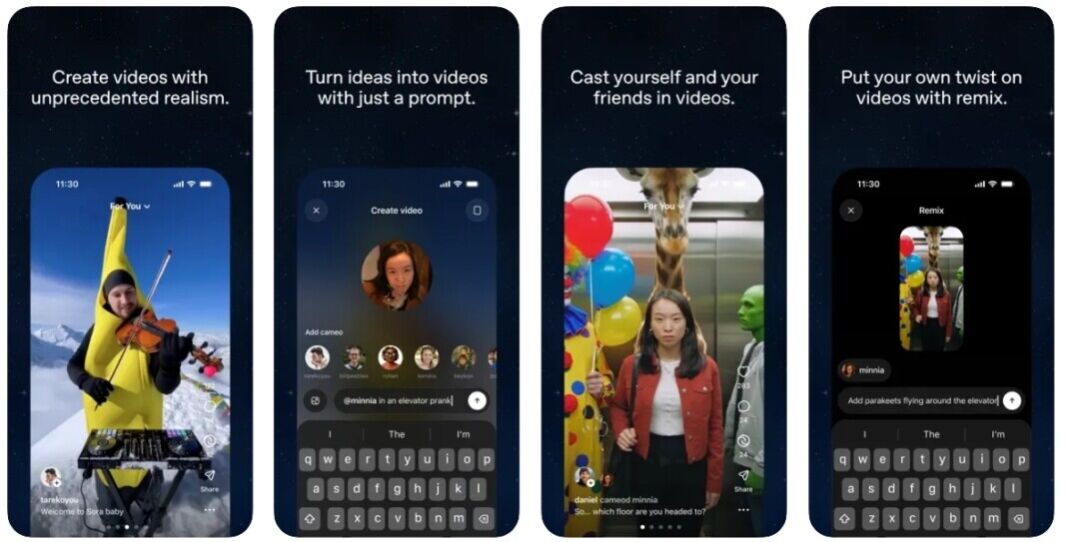
Ironically, OpenAI showed foresight on the related issue of personal likeness. The app’s ‘cameo’ feature, a tool for creating personal deepfakes, launched with a robust consent framework, a safeguard that stands in stark contrast to the initial free-for-all with copyrighted characters.
The conflict highlights the deep, unresolved tensions over AI training data, often called AI’s “original sin.” While OpenAI may see Sora 2 as a step toward AGI, Hollywood sees it as a direct assault on its intellectual property, setting the stage for a protracted battle.